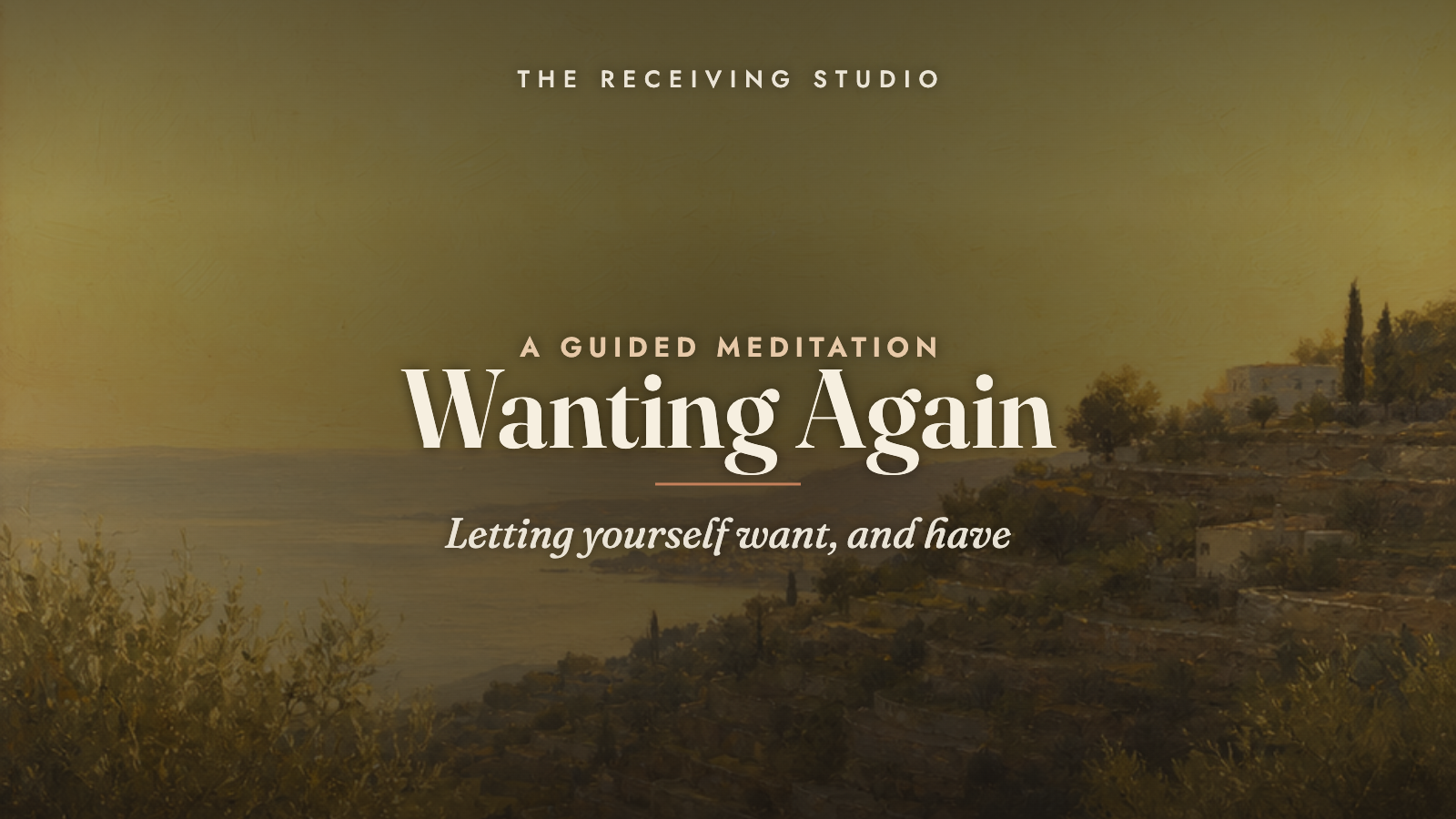
A Guided Meditation for Letting Yourself Want Again
In this meditation, you walk down a forest path into an old mountain village on a golden autumn afternoon. You move through its little market and let yourself want, and take, five beautiful things, one for each of your senses, until you feel awake again. It is a meditation for letting yourself want, and it ends in sleep.
Read this through a few times until the walk feels familiar. Then, at night, you can take it yourself with your eyes closed, or record yourself reading it and let your own voice lead you there. There’s no clock on this. Some nights you’ll be asleep long before the end, and that’s just as it should be.
Lie down flat on your back. Let your feet fall apart, a little wider than your hips. Rest your arms a few inches out from your sides, palms open and facing up. Loose and easy, like a starfish that isn’t trying. Let the bed take all of your weight. You don’t have to hold yourself up anymore tonight.
Take five slow, deep breaths, and count them with me.
In, all the way. And out. That’s one.
In. And out. Two.
In. And out. Three.
In. And out. Four.
In. And out. Five.
Let your breathing settle back into its own quiet rhythm. You don’t have to control it now.
Now let your body go, one piece at a time.
Start with your hands, resting open beside you. Let them soften all the way. Let the fingers uncurl. There’s nothing left to hold tonight.
Let your face soften. Unclench your jaw and let it hang loose, let your teeth part. So much of the day sits in the jaw. Let this be where you put it down.
Let your eyes rest. Not squeezed shut, just still and heavy behind your eyelids. Let them stop looking, even in the dark.
Now let your feet go. Let them fall open, heavy. Let the last of the day drain out of them, all the way down and out.
Now that your whole body is loose, take three more slow breaths, and count them.
In. And out. One.
In. And out. Two.
In. And out. Three.
Every part of you is resting now. There’s nothing left to do tonight but this.
Now, in the dark behind your eyes, a path is beginning to appear.
You are standing on a narrow path in a forest. Feel the ground under your bare feet. It is packed earth, cool and a little dusty, with dry leaves scattered across it.
The trees on either side of you are tall and old. It is autumn here, and their leaves have all turned, gold and amber and rust. Look up for a moment. The light is coming down through the branches in soft patches. Some of it is landing on the path ahead of you, and some of it is falling across your skin, gentle and warm.
Breathe in slowly. The air is fresh and clean. You can smell the dry leaves, and the earth beneath them, and, somewhere far off, a thread of woodsmoke.
There is nowhere you need to be. No one is waiting for you. The whole afternoon belongs to you.
So you begin to walk. Taking your time. In no rush at all.
You hear a bird chirping somewhere up in the branches. And then, further off, you hear another one chirp back. A breeze is moving through the tops of the trees, and a few leaves are coming loose and drifting down around you, turning as they fall. One of them lands on your arm. You brush it away, and you carry on.
The path is beginning to curve, and as it does, the trees ahead of you are starting to thin. More light is reaching in between the trunks. And through the gaps, in the distance, you can see something.
Look. Far below you, down in a wide green valley, there is a village.
You keep walking toward it, one easy step after another. And with each step the trees fall back on either side of you, until the last of them slip behind your shoulders, and the whole valley opens up in front of you.
You come to a stop, and you take it in.
Mountains are holding the valley on every side. Look up at them. Their peaks are grey stone, high and sharp, with the first snow of the year dusted white across the top. Below the snow, their slopes are covered in forest, spilling down toward you in patches of green and copper and gold. And at the bottom, gathered along a bright river, sits the village.
You can see small stone houses with steep timber roofs. You can see wooden beams gone silver-grey with age, and window boxes still full of late flowers, and doorframes painted in faded blues and reds. From each chimney, a thin line of smoke is rising straight up into the still air.
There is nothing modern anywhere. No wires overhead. No engines. No glass or steel. Everything your eyes land on looks the way the world looked two hundred years ago, and it feels lived-in, and gentle, and completely safe.
Listen for a moment. The sound of the village is drifting up the hillside to reach you. Somewhere a bell is ringing. Voices are calling to one another across the rooftops. A horse is walking on stone, slow and even. And underneath all of it, the wind is coming down off the peaks and moving through the long grass around your feet.
You walk down the last of the slope, and you step into the village.
The way beneath you turns to cobblestones, old and rounded and smooth, cool against the soles of your feet. The lane winds in between the houses, and there are people here, going about their day.
A woman comes toward you with a basket of red apples balanced on her hip. She is wearing a long grey skirt and a shawl the colour of ripe wheat, and as she passes she catches your eye and smiles, as though she knows you. A little further along, a man in a leather apron is leading a shaggy brown horse loaded down with firewood, the logs creaking softly against the ropes with every step. Two children run past your legs, laughing, chasing a small dog that has a stick clamped in its mouth. And in a doorway, an old man sits on a three-legged stool, mending a broken shutter across his knees, and he looks up from his work and nods to you, slow and kind.
You follow the lane as it opens out, and it brings you into the town square.
Stop here, and look around you.
The square is wide, paved end to end with those worn cobblestones, and ringed with old stone buildings leaning gently against one another. The mountains rise up behind their rooftops, and their shadows lie across the stones in long blue bands where the sun hasn’t reached. It is the middle of the day, and the whole place is alive, though never loud. Just full, and busy, and easy.
Along one side of the square, market stalls are set out under striped canvas. You can see them heaped with pumpkins and pale squash, with baskets of apples and pears, with round dark loaves and wheels of yellow cheese and jars of honey lined up catching the sun. A stallholder in rolled-up sleeves is calling out his prices, cheerful, to no one in particular.
Look at the shops around the edges. Their wooden shutters are thrown open, and things are hanging outside every one of them. Over one doorway, long braids of garlic and thick bunches of dried herbs, rosemary and sage and lavender, swinging a little in the breeze. Over the next, a row of copper pots and pans, polished bright, throwing back the light. Strings of paper lanterns, not yet lit, are looped from shop to shop above your head. Bolts of coloured cloth stand propped in a doorway. Baskets of wool spill out onto the step of another.
In the middle of the square there is a stone well with a little wooden roof over it, and a young woman is there, drawing up a bucket of water on a rope, hand over hand. A dog is stretched out asleep on the warm stones nearby, one ear twitching. And over in a shaded corner, an old man is sitting on a barrel with a fiddle tucked under his chin, playing something slow and sweet, just for himself.
People are moving all through it. Buying, selling, stopping to talk. A woman is choosing pears, turning each one over in her hand. A boy is carrying a tray of bread on his head. Two old women are laughing together by the well.
Take a slow breath in. You can smell it all at once, the fresh bread, the herbs, the cut flowers, the woodsmoke. Somewhere the fiddle keeps playing. And the sun is lying golden across the whole square.
And standing here, in the thick of it, something happens in you. You feel a small tug. A pull toward one of the shops across the way. It is the feeling of wanting something, and it stirs in you the way it used to, a long time ago.
Notice that pull. And notice, too, what rises up right behind it. The quick, quiet habit of talking yourself out of it. The little voice saying you don’t really need anything, that it is easier not to want, that wanting only leaves you let down. Feel how fast it moves to switch the feeling back off.
But here, none of that holds. In this village, nothing you want can be lost. Nothing you pick up will be taken back from you. No one is counting, and no one is watching to see if you reach for too much. Here, wanting is safe. And whatever you want, you get to keep.
So follow the pull. Let it lead you. The first shop is right across the square.
You make your way over the cobblestones toward it, through the mellow light, past a stall of apples and the old fiddler in his corner. And as you come near, you see what it is. It’s a weaver’s shop.
Through the open window, baskets of dyed wool are heaped in every shade there is, midnight blues and berry reds, oat-coloured creams, mossy greens. Skeins of yarn are hanging down from the beams. Folded cloth is stacked in neat towers along the sill. And in the corner, a tall wooden loom stands strung with half-finished cloth, the threads catching the light.
You step through the doorway. Inside, the shop is dim and snug, and the air smells of clean fleece and old cedar. A woman is sitting at the loom, silver threaded through her dark hair, and she is working the pedals and passing the shuttle back and forth with an easy, practised rhythm. She glances up at you, and she smiles, and she says nothing at all, because she can see you have come to look.
So you look. And you do more than look. You reach out and let your fingers move over things. You draw your hand down a bolt of thick woven cloth and feel the weight and the grain of it. You lift a bundle of yarn and hold it against your cheek, and it is downy, almost weightless. You wander deeper into the shop, letting your hands find whatever they please, the ridge of a carved button, the fringe of a blanket slipping between your fingers, the deep pile of a folded rug.
Your fingertips are waking up. You had forgotten how much they were able to feel.
And then something stops you. A shawl, folded over the end of the counter, in a colour that reaches out and holds you. Maybe it is the deep blue of the sky just after the sun goes down. Maybe it is silver-grey, or the gold of the mountain slopes, or a green like the moss on the river stones. Whatever it is, it is the one that pulls at something inside you. Not the sensible choice. Not the one you ought to take. The one you love.
And there it is, that old habit, rising up in you. The small voice telling you to put it back, you don’t need it, don’t be foolish, don’t reach for so much.
But this is yours to want. And here, it is yours to have. So reach out, and take it.
You lift the shawl and shake it open, and you draw it around your shoulders. It has been sitting in the sun, and the heat of it soaks straight into you, and it hangs on your body as though it was woven to your shape. The weaver dips her head from her loom. It belongs to you now. You wear it back out through the door and into the square, wrapped and warm, a little more here than you were a moment ago.
Rest for a breath. Feel the wool sitting on your shoulders and its gentle weight down your back. You wanted something. You let yourself have it. And nothing went wrong. No one stopped you. Nothing broke apart. You are simply wrapped now in something you chose, for no reason but that you loved it.
You turn back into the square, and as you do, a new pull takes you, off toward the far corner. You follow it, past the well where the young woman is still hauling up her water, past two men rolling a barrel over the stones. And halfway there, it reaches you.
A smell. Baking bread. Melting sugar. Cinnamon, and cloves, and honey heating somewhere over a fire. It is the baker’s shop, and as you come to the open door the scent wraps right around you, rich and sweet, and your mouth begins to water, and it strikes you that you cannot remember the last time you were truly hungry for something. The last time eating was a pleasure, and not just one more thing to be got through.
You step inside, into the heat rolling off the ovens. Round loaves are cooling in rows along the shelves. Trays of little cakes sit dusted in fine white sugar. A wide clay pot of honey stands open on the counter, the comb still floating in it, thick and unhurried. The baker is a broad man with flour up past his elbows, and without a word he cuts a piece of spiced cake, so fresh that the steam is still curling off it, and he holds it out to you on the flat of his hand.
You take it. And you taste it.
The flavour blooms across your whole mouth. The heat of the spice. The dark sweetness of the honey. The tender crumb dissolving on your tongue. Butter, and cinnamon, and something deeper underneath it all. Your eyes fall closed on their own, and you taste it properly, without hurry, and it is so good that you feel it travel all the way down through you. You had forgotten this, too. You had forgotten that a plain thing could taste this good, that a pleasure this simple was allowed, that it had been sitting here the whole time, waiting for you to come back to it.
There is nothing here to feel guilty for. You are free to enjoy this all the way. You are even free to want more.
So you take a second piece, in no rush, and you let the baker fold a slice into a square of cloth for you to carry away, and you step back out into the daylight with the honey still on your lips, your mouth awake, a glow spreading through you now from the inside.
Pause here a moment. Let yourself notice how good that was. Nothing is chasing you. The market isn’t going anywhere. The whole day is yours to spend.
The next tug arrives on the breeze, sweet and green, carried across the square. Flowers. You turn toward it and follow it, past the fiddler, past a child selling bundles of kindling, until you come to a stall buried under blossom, pail after pail of it, and cut herbs tied in bunches, more colour gathered in one place than you have set eyes on in years. An old woman sits in the middle of it, tiny and sun-browned, beaming out at you from behind the blooms.
You lean in close, and you breathe.
And the scent pours straight into you. Roses, heavy and sweet. Lavender, clean and settling. You brush your palm across a bunch of rosemary and mint, and they give up their sharp green smell into the air around you. Underneath it all is the raw scent of cut stems and damp soil. You draw it right down to the bottom of your lungs, and something in you that had been sleeping stirs, and lifts its head, and opens its eyes.
There is no practical reason to buy flowers. They do no work. They will be gone within the week. And once, that alone would have been enough to walk you straight past them.
But wanting a thing for no reason but its beauty is exactly what is allowed here.
So you gather up a bunch. Only the ones you keep drifting back to. The old woman winds a length of twine around the stems and lays them across your arms, and you lift them to your face and fill your lungs one more time before you go, carrying an armful of colour and scent that you chose for nothing at all except that it makes you happy.
Take a slow breath in through your nose. Smell the flowers you are holding. And notice, now, that you are carrying three things, every one of them wanted, every one of them chosen by you. Notice, too, that more of you is awake than when you first came down off the hill. Something is coming back.
Across the square, the sun catches something and scatters back in a spray of colour, and it pulls your gaze. You go toward it, weaving between the stalls, and you find a narrow shop full of glass and light. Set in the window are shards and panes of coloured glass, hanging lanterns, little birds and stars and bowls, all of it glass, and where the daylight passes through it, colour is thrown across the walls inside, crimson and sapphire and gold, sliding slowly as the sun moves overhead.
You step in, and this time you only watch. You had forgotten how much there is to see, once you truly look. You follow the colours as they drift across the plaster. You pick up a blue glass bird and raise it to the window and watch the light pour through it and set it glowing in your hand. You turn a lantern this way and that and see the patterns it casts across your palm.
None of this is of any use. That is the whole point of it. It was made only to be beautiful, only to be looked at, only to be delighted in.
You do not have to explain loving a thing. You are allowed to simply love it, and take it home. So you choose one. The blue glass bird, perhaps, or a lantern, or a single pane of glass that will catch the morning at your window. Whichever one lifts the corner of your mouth. You close your hand around it, and it is yours, and you carry it out to join the rest.
Breathe. You are nearly there now. One more is waiting.
And this last pull comes to you as sound. From a corner of the square you haven’t reached yet, clear and delicate over everything else, a tiny melody is turning. You trace it to a shop crowded with instruments, hanging bells, and wind chimes that spin gently in the doorway. Along the counter sits a row of wooden music boxes. The shopkeeper is a slight old man with quick, bright eyes, and when he sees where you are looking, he winds one of the boxes and lifts its lid.
A tune spills out. Bright, and sweet, the notes tumbling over one another in the hush of the shop.
And you listen. Truly listen, the way you just listened to the flowers and the cake and the wool, with the whole of yourself. You had turned the sound of the world down along with everything else, and here it is again, this perfect thread of music in a crowded shop high in the mountains, and it is so beautiful that it makes your eyes prick, just a little, in the best possible way.
You are allowed to be moved by a small thing. And you are allowed to carry it home with you.
So you choose the one whose song reaches you most. The old man lowers the lid and sets it in your hands, and it sits there, heavier than it looks, still holding the heat of his shelf, and you carry it out to join everything else.
And now you are standing in the middle of the square once more, in the last low gold of the day, and you look down at all you are holding. The shawl across your shoulders. A slice of honey cake wrapped in cloth. An armful of flowers. A piece of glass that drinks the light. A music box with a song you love.
Five things. And not one of them did you choose because it was useful, or wise, or needed. You chose every single one because you wanted it. Because it was beautiful, or it felt good, or it made you glad. And you let yourself keep all of it.
You are more awake now than you have been in longer than you can say.
Over by the well, an old woman is sitting in the fading light, tiny and still, her face gathered into a hundred fine lines. She has been watching you move through the market, and as you come near she takes in your full arms, and the new shawl, and the flowers, and she smiles.
“It’s good to see you wanting again,” she says. Her voice is low, and steady, and sure. “You were never meant to stop.”
And that is all she says. She does not explain it. She has no need to. You already know that it is true.
You lower yourself onto the sun-heated stone beside her and rest there a while, your things gathered in your lap, and together the two of you watch the light change over the peaks. And it does change. By slow degrees, the gold sinks into amber, and the amber into a dusky rose. The sun slides down toward the tallest of the mountains. Around the square, the market is folding itself away, shutters easing shut, cloths drawn over the stalls, the whole place settling into stillness. In the windows, one by one, small flames are being lit, until the square is ringed with points of firelight. The air is cooling now, and you are glad of the wool around your shoulders.
You are tired. It is a good kind of tired. You feel full, and settled, and at peace.
The old woman gets to her feet, and she folds your hand into hers, and she leads you across the darkening square to a low stone house at its edge, a candle glowing behind the window. Inside is a single room, plain and clean, a fire burning down to embers in the grate, and a bed piled high with blankets and sheepskin.
You go in. One by one, you set your things beside the bed, where your eyes can find them. The shawl. The flowers, standing in a cup of water. The glass, on the sill, ready to catch first light. The cake, saved for morning. And the music box.
You wind the music box once and set it down, and its song begins again, quiet in the stillness of the room.
Then you climb into the bed. The blankets come down over you, heavy and snug. The sheepskin is tender against your skin. The last of the fire glows low and orange, and beyond the window the village has gone dark and silent, and the mountains are standing guard all around you in the night.
You lie back. Everything you wanted is here beside you. Everything you let yourself take. The music box plays on, softer with every turn, its song slowing, winding down toward stillness. The embers tick and settle in the grate. You are held, and you are full, and there is nothing left to want tonight, because tonight you let yourself have all of it.
And as the last notes of that little song fade into the quiet, and the blankets hold you close, and the mountains keep their watch, you let yourself sink down, and down, into sleep.
This meditation is yours to keep. Read it until the walk lives in you, then take it yourself each night, or record it in your own voice. And if you’d rather simply close your eyes and be carried, the recorded collection is on its way: each meditation read slowly, over soft, natural sound, so you don’t have to read or remember a thing.