A Guided Meditation for Letting Yourself Receive
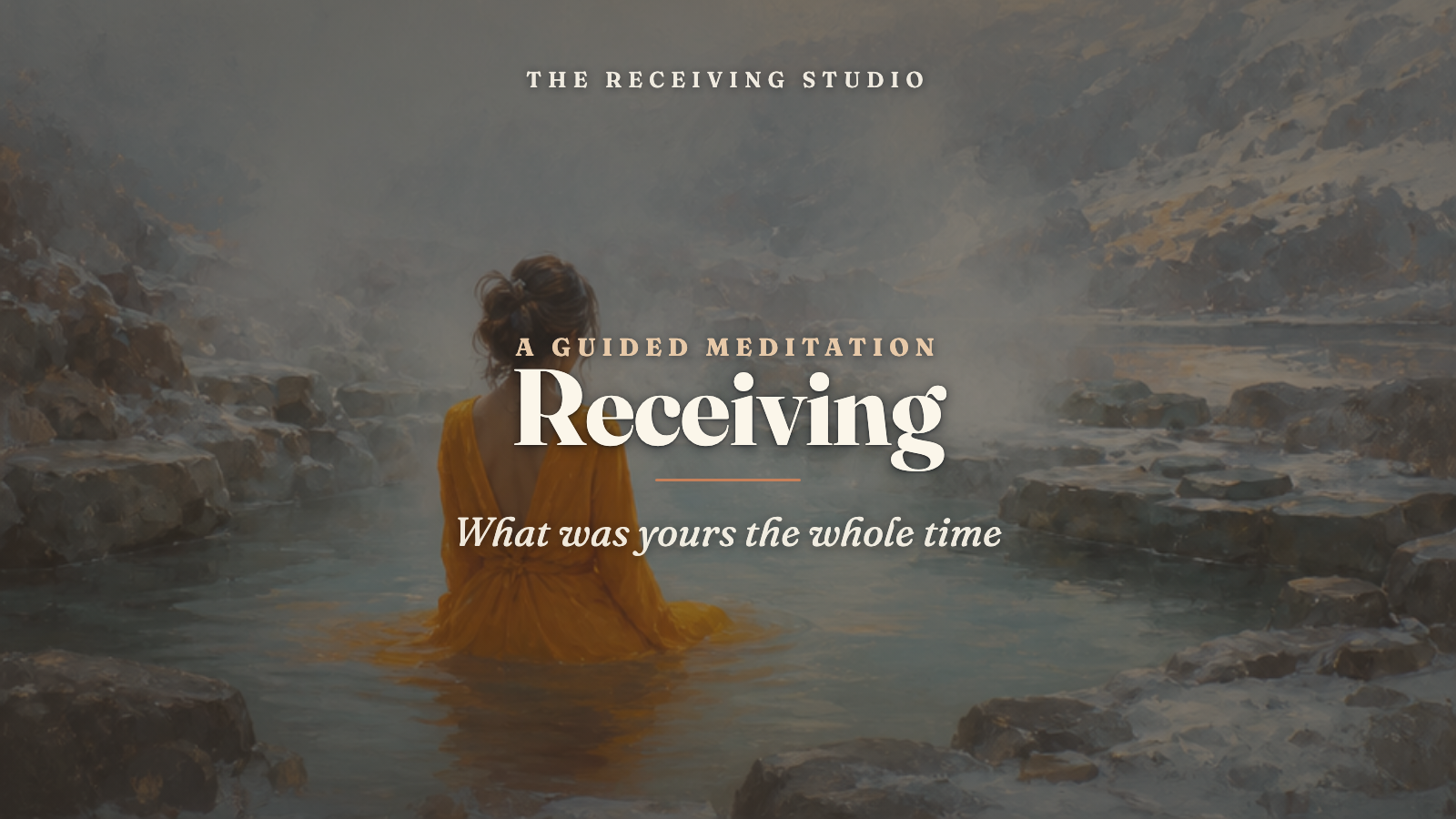
In this meditation, you walk down through the snow from a mountain village to an old stone bathhouse you have come to many times before. Every time until now you have stopped at the first plain pool and gone no further. Tonight you finally go through the beautiful door you have always refused, into warm and lovely waters that were kept ready for you the whole time. It is a meditation for letting yourself receive, and it ends in sleep.
Read this through a few times until the way down the mountain feels like somewhere you know. Then, at night, you can take it yourself with your eyes closed, or record yourself reading it slowly and let your own voice carry you down. There is no clock on this. Some nights you will be asleep long before the end, and that is exactly right.
Lie down flat on your back. Let your feet fall apart, a little wider than your hips. Rest your arms a few inches out from your sides, palms open and facing up. Loose and easy, like a starfish that isn’t trying. Let the bed take all of your weight. You don’t have to hold yourself up anymore tonight.
Take five slow, deep breaths, and count them with me.
In, all the way. And out. That’s one.
In. And out. Two.
In. And out. Three.
In. And out. Four.
In. And out. Five.
Let your breathing settle back into its own quiet rhythm. You don’t have to control it now.
Now let your body go, one piece at a time.
Start with your hands, resting open beside you. Let them soften all the way. Let the fingers uncurl. There is nothing to hold onto tonight.
Let your face soften. Unclench your jaw and let it hang loose, let your teeth come apart. So much of the day is held in the face. Let this be where you lay it down.
Let your eyes rest. Not squeezed shut, just still and heavy behind your eyelids. Let them stop searching, even in the dark.
Now let your feet go. Let them fall open, heavy. Let the last of the day pour out of them, all the way down and out through your heels.
Now that your whole body is loose, take three more slow breaths, and count them.
In. And out. One.
In. And out. Two.
In. And out. Three.
Every part of you is resting now. There is nothing left to do tonight but this.
Now, in the dark behind your eyes, a place is beginning to appear.
You are standing high up on a mountain, at the edge of a small village, and it is winter. Snow is falling around you, slow and soft and silent, the kind that drifts down without any hurry and settles over everything. You are wrapped up warm against the cold, a heavy coat buttoned to your chin, a thick scarf wound around your neck, sturdy boots on your feet. Your breath is showing in front of you in soft clouds.
Behind you, the village is settling into the evening. Small houses of dark timber and grey stone, their roofs loaded with snow, sit close together along a narrow lane. Smoke is rising straight up from every chimney into the still air. In the doorway of one house, a woman in a red shawl is shaking the snow off a blanket. Further along, a man with a lantern is stacking split logs against a wall, his shoulders dusted white. A window here and there is glowing amber, someone lighting the lamps early against the dark.
Breathe in slowly. The air up here is cold and clean, so clean it feels like it is rinsing you from the inside. You can smell woodsmoke on it, and pine, and the strange bright nothing-smell that snow has.
You turn away from the village and look down the mountain. A path leads down from where you stand, its stones worn smooth, softened now under a blanket of fresh snow. It winds down between tall pines whose branches are bowed low under all that white. And far below you, tucked into a sheltered fold of the mountainside, there is a low stone building with steam pouring up off its roof and warm light burning in its little windows.
You know that place. You have been going there for years.
So you begin to walk down toward it, taking your time, your boots pressing soft prints into the snow. There is no rush in you tonight and nowhere else you need to be.
The path curves down through the pines. Snow is still coming down all around you, catching in your eyelashes, gathering on your shoulders. Somewhere off in the trees a branch gives up its load with a soft thump. The light is beginning to change, the white going faintly blue as the day sinks behind the peaks. Your feet know the way. Down, and down, one careful step after another, until the trees fall back and the little stone building is right there in front of you.
Stop a moment and look at it.
It is old, older than anyone can say, built low and solid out of great blocks of grey stone gone soft at the edges with age. Snow sits thick on its roof, and from vents along the top, steam is rising and curling away into the cold. The windows are small and set deep in the walls, and each one is lit from within, warm and yellow. You can hear water now, running somewhere inside, a low and constant trickle. And under the woodsmoke there is another smell, faint and mineral, warm stone and hot spring water.
You go to the heavy wooden door and push it open, and you step inside, and you pull it shut behind you against the cold.
You are in a small entrance room, warm and dim and quiet. The stone floor beneath your boots is heated from below, and the heat of it is already rising up to meet you. There are wooden benches along the walls, and pegs for hanging things, and a few pairs of boots already lined up neatly on the floor.
So you begin to take off the cold.
You unwind your scarf from your neck and hang it up. You unbutton the heavy coat and let it come off your shoulders, and it feels good to be out of its weight. You sit on the warm bench and pull off your boots, one and then the other, and peel away your thick socks. And then you stand, and you put your bare feet down flat on the warm stone floor.
Feel that. The heat coming up into the soles of your feet, spreading up through you. You have set down everything you were carrying against the cold, all the layers you wrap around yourself out there in the world, and you are lighter now, and warmer, standing here with nothing held and nothing to protect.
You step through into the first room, the one you always come to.
It is a simple, quiet room. The walls are bare grey stone, worn smooth by years of steam. High up, a small window is letting in the last of the blue evening light. In the middle of the floor there is one plain pool, square and old, its edges rounded soft. The water is clear and warm, and steam is rising gently off the top. A few thin towels hang from a wooden peg on the wall.
This is where you always stop. You come down the mountain, you slip into this warm, plain water for a while, and then you dry off and go home. You have never gone any further than this room.
But tonight, look across to the far wall.
There is a door there.
It is a beautiful door, tall, made of dark carved wood, worn smooth and shining where hands have touched it over the years. Warm golden light is spilling out from under it and through the seams around its edges, softer and richer than the plain lamplight in here. And listen for a moment. There is a sound coming from behind it. Water moving, gently. And something almost like music.
Beside the door, an old woman is sitting on a small three-legged stool. She is very old, and very small, her face soft with deep folds, a woven shawl around her shoulders, her hands resting in her lap. She is not waiting for anything from you. She simply keeps this door.
She is here every time you come. And every time, she looks up at you kindly and tells you, in a low and easy voice, that there is more through here whenever you are ready, and that you are always welcome to come in.
And every time, you have smiled, and thanked her, and turned back to your plain little pool instead.
But tonight, you are tired of turning away from the warmth.
Tonight, you look over at the old woman, and you meet her eyes, and you find that you are ready to go in.
You give her the smallest nod.
And without a word, she smiles, and she rises from her stool, and she reaches out and turns the worn brass handle, and she opens the beautiful door, and she holds it, and she waits for you to come through.
So you walk to the door. And you step through it.
And you stop, just inside, and you take it in.
The room on the other side is beautiful. It opens up wide beneath a low stone dome, and the whole of it is glowing with warm light, from lanterns set into the walls and from a fire burning low in a stone hearth to one side. The air in here is thick and warm and soft with steam, and it wraps around you the moment you enter.
There is not one pool here but several, each one sunk into the smooth stone floor, and warm spring water is running between them along carved channels, so that the whole room is alive with the gentle sound of moving water. Steam is drifting up off every surface and catching the light as it rises.
And everywhere you look, things have been set out, ready, waiting. Along one wall, thick towels are stacked in soft folded piles, warming by the fire. There are bowls of pale bath salts and dried flowers set beside each pool. On a low table there are little dishes of food, plump figs and dates, a piece of golden honeycomb, a bowl of nuts still warm and spiced. A clay pot of tea is sitting near the fire to keep hot. Soft robes are hanging from carved hooks on the wall, and there are cushioned stone benches to lie back on.
And there is no one here. The whole warm room is empty, and quiet, and completely yours. Nobody to talk to. Nobody to look after. Nobody watching to see what you take, or how long you stay. All of this was made ready and left here for you, and tonight there is not another soul in it.
This was here the whole time. Just behind the door. Waiting for you, on all those cold nights you turned around and went home.
Take a slow breath in. Under the steam you can smell roses, and something green and fresh, and warm honey, and the woodsmoke from the fire.
Behind you, the old woman rests a light hand on your back, the gentlest push forward, into the room. And then she draws the door quietly closed and leaves you to it, and the whole warm place is yours alone.
The first pool is right in front of you, and its water is the colour of warm milk, soft and pale and just barely cloudy, with pink and cream rose petals scattered across the top of it, turning slowly where the current moves them. The water is thin and clear enough to move easily, not thick, just gently coloured and sweet-smelling, and the steam coming off it carries the scent of roses right to you.
You step down into it.
The warmth climbs up your legs as you lower yourself in, and you sit down on the smooth stone ledge under the water, and let it come up over your shoulders. The petals drift in against your skin and rest there. The smell of the roses is all around your face now, delicate and lovely.
And straight away, there it is, the old feeling. The small voice that says this is far too much, that you do not need rose petals and warm milk, that plain water would have done you fine. The urge to keep it brief. To not get too comfortable. To not let yourself be softened.
But not tonight. Tonight you let yourself sink all the way in.
Feel how good this is. Let your head tip back against the warm stone. Let your whole body go loose in the water, held and cradled by the warmth. You are allowed to be here. You are allowed to enjoy it slowly. Stay here for a few breaths, and let the roses do their quiet work.
On the stone edge beside you there is a smooth wooden bowl, set out ready. Reach for it. Dip it into the pool, and lift it, and pour the warm water slowly over your hair.
Do it again. And again. Warm water running over your hair and down the back of your neck, unhurried, as many times as you like. Nobody is rushing you. There is nothing else you need to be doing. Take care of yourself slowly, the way you would take care of someone you loved.
When you are ready, rise up out of the water, and lift one of the warmed towels from the pile by the fire and wrap it around your shoulders, and sit down on one of the cushioned benches beside the hearth.
The little dishes are right there within reach. Figs, split open and soft. Dark honeycomb, glistening.
Take a fig, and eat it slowly, and it is soft and sweet on your tongue. Take a piece of the honeycomb and let it melt on your tongue, rich and golden. Pour yourself a cup of tea from the pot by the fire, and drink it, and when the cup is empty, fill it again. Take as much as you want. There is plenty of everything, and all of it was left here for you, and no one is counting.
Rest here a moment. Warm through, well fed, your hair damp against your neck. Notice how good this feels. There is nothing to do here but let yourself be well.
When you are ready, you rise, and you move to the next pool.
This water is clear, perfectly clear, so clear you can see straight down to the smooth stones at the bottom. Floating on the surface and drifting through it are fresh green sprigs, rosemary and mint, soft grey sage and dark pine, and thick fragrant steam is lifting off the top. As you come near, the smell reaches you, sharp and green and clean, and it opens something in your chest.
You step down into the clear water and settle in among the floating herbs. Breathe the steam in deeply, all the way down. It is bright and cool in your nose even as the water holds you warm, and with every breath your head feels clearer, your thoughts quieter, like a window has been opened in a stuffy room.
You brush your hand through the water and the sprigs turn and circle around your arm. You lean back against the edge and let the fragrance work through you.
Let yourself linger here. Stay in the clear, fresh water as long as you like. No one is waiting. Nothing is being neglected. This time is yours, and there is plenty of it.
When you finally step out, you take up your towel and pull it around your shoulders, and you cross to the third pool.
And this one stops you where you stand, because it is the loveliest thing you have seen.
The water is a warm amber gold, still thin and clear enough to move through easily, and drifting all through it are tiny flakes of real gold. They turn and glint as the water moves, rising and sinking, catching the lantern light and throwing it back in little sparks. The steam above it smells faintly sweet, like warm honey.
You do not hesitate this time. You step straight down into it.
And the warm golden water closes over you, and the tiny flakes drift and settle across your skin, along your arms, over your hands, glinting there like you have been dipped in light. Lift your arm slowly out of the water and watch the gold slide and shimmer over it. Turn your hand and see it catch the lantern glow.
Let yourself have this. It is here, and it is beautiful, and you walked through the door to it. Sit in the warm gold and let it be yours. Stay for a few slow breaths.
And when you rise from it at last, you gleam.
There is one more pool, set a little apart from the rest.
This water is clear and cool, fresh and clean, moving gently as the spring feeds it. This is the last one. This is where you rinse everything away.
You step down into the cool, clear water, and it is a bright, clean shock after all that warmth, waking your skin, sharpening you. You dip beneath the surface and come up again, and you feel the milk and the herbs and the honey and the gold all rinse away and swirl off downstream, until there is nothing left on you but clean skin and cool water.
You come up out of that last pool clean, and new, and light. Every bit of the long cold day is gone from you. Every layer you walked in wearing, inside and out, has been set down and washed away.
You take the thickest, softest of the warmed towels from the pile by the fire and dry yourself off, and you lift one of the robes down from its hook and wrap it around you, and it is warm from the fire and soft against your skin.
And when you turn around, the old woman is standing quietly in the doorway. She comes to you, and she folds the robe a little closer at your throat, and for a moment she holds you by the shoulders and looks at you, pleased.
“You never had to stay out there in the cold,” she says. Her voice is low, and warm, and certain. “This was yours the whole time.”
And that is all she says. She does not explain it, because there is nothing to explain. You already know that it is true. It was always true. The door was never locked. It was only ever you, standing out in the plain room, telling yourself you did not need what was waiting on the other side.
She takes your hand, and she leads you across the warm room, past the glowing pools and the low fire, to a small doorway in the far corner. Beyond it is a little room, plain and snug, with a fire burning down to soft orange embers in a small hearth. Through the wall you can still hear the water moving in the baths, a low and endless murmur. And against the wall there is a bed, piled deep with heavy blankets and soft woollen throws.
She leaves you there, and closes the door softly behind her. And you climb up into the bed in your warm robe, and you pull the blankets over you, and they come down heavy and warm across your whole body.
Lie back into them. You are warm all the way through, warmer than you have been in longer than you can remember, warm right down into the middle of you. Your skin is clean and soft. Your hair is drying against the pillow. There is honey still sweet on your lips and the fresh green of the herbs still faint in your breath.
You did not turn away tonight. You went through the door. You let yourself be warmed, and fed, and made beautiful, and clean, and you took your time over every bit of it. You let it all in, and nothing bad came of it, and no one took anything from you, and you did not have to earn a single moment of it. It was simply given, because it was always yours to have.
The fire settles low in the little hearth. The water keeps up its soft sound through the wall. The snow is still falling somewhere outside in the dark, but you are deep in the warm heart of the mountain now, held and clean and full, with nothing left to do and nowhere left to go.
And as the blankets hold you close, and the last of the embers glow down to nothing, and the water murmurs on and on, you let yourself sink down, and down, into sleep.
This meditation is yours to keep. Read it until the way down the mountain lives in you, then take it yourself each night, or record it in your own voice. And if you would rather simply close your eyes and be carried, the recorded collection is on its way: each meditation read slowly, over soft, natural sound, so you don’t have to read or remember a thing.